They came on Sunday afternoon, the sixteenth, without a call. I was in the driveway coiling a hose I had no real reason to coil, and I saw the gray sedan slow at the curb and stop crooked, the way people park when they expect to be quick.
Diane got out first, purse tucked under her arm like a clipboard. Nolan followed from the driver's side, hands in his jacket pockets, looking at our house as if it had been priced. I had not seen him in four years. He had gotten heavier in the face.
I went inside and told Mara. She was at the kitchen table with her tea and a legal pad. She looked at the window, then at me, and set her pen down very squarely.
"I'll go out," she said. "You stand by the porch post. Not the gate. Close enough to hear."
"Whatever you want."
"That's what I want."
She walked down the path and stopped with the gate between her and her mother. She did not open it. I took the post, hose still in my hand, which felt ridiculous, and I kept it anyway.
"Mara," Diane said, with a warmth that sounded rehearsed in the car. "We were in the neighborhood."
"No, you weren't. It's forty minutes."
Diane let that pass. "We came to do this like family. Mr. Fenwick says everything is held up on one signature. Yours. Your father is not well with the stress of it. Nolan has people waiting."
"I'm not signing today."
"Nobody is asking for an apology," Nolan said, and I understood he meant it as a gift. "We just need the paper. It's a formality."
"Then it can wait for the formality of answers," Mara said. "I asked for records. Celia Navarro has them. If you have questions about money, she's the person to ask, and she'll tell me."
"Celia," Diane said, as though tasting something. "A stranger you hired against your own family."
"I hired her to read a document. You can send her whatever you like."
Diane's eyes slid past her to me. "He's behind this."
I felt the old reflex rise, the sentence I had drafted in my head a dozen times. Mara did not turn around. I kept my mouth shut and my hand on the post. It was the hardest job I'd had all month.
"Owen is standing on his own porch," she said. "I'm the one talking."
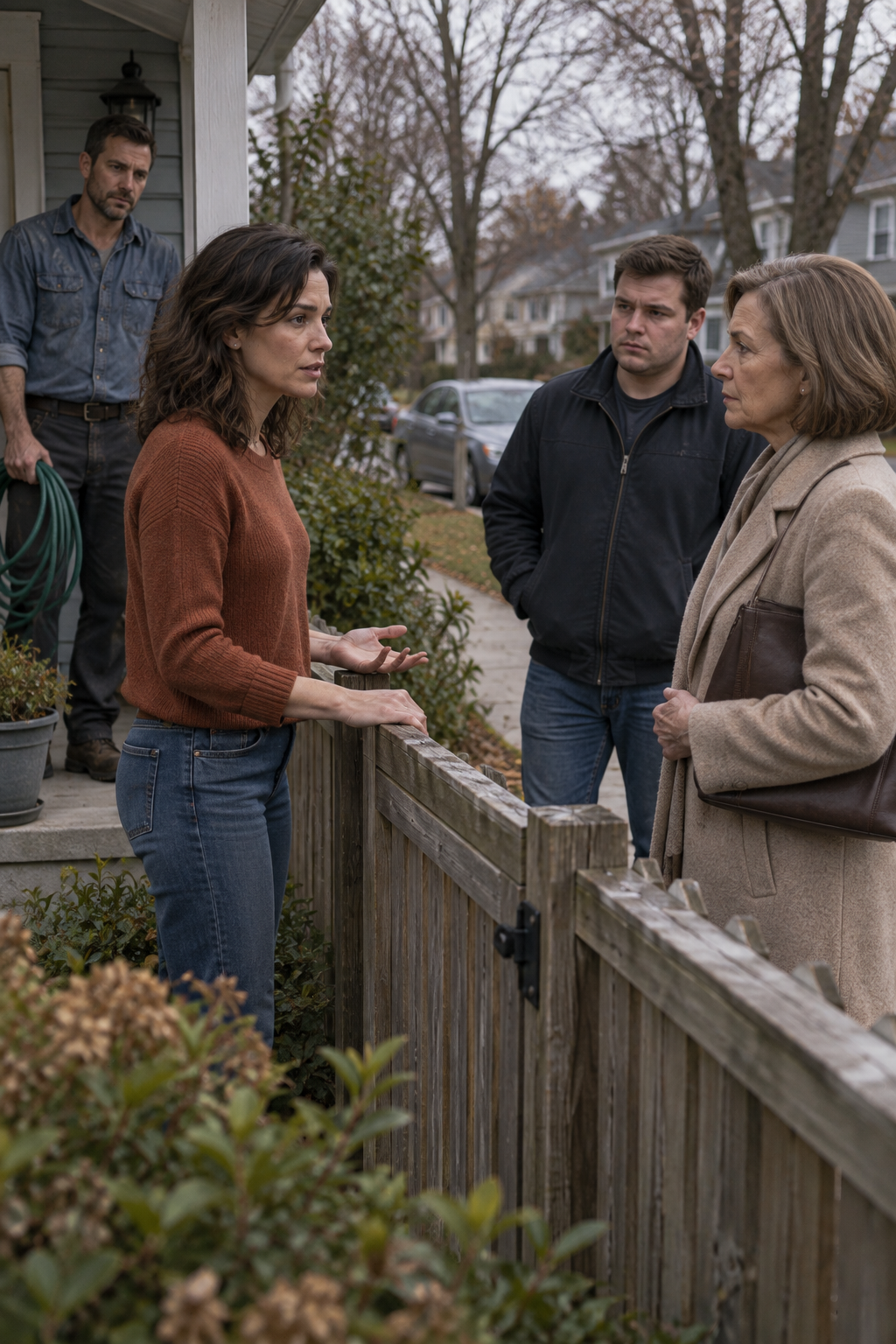
Nolan shifted his weight. "Look, you don't even need your part. You've got a house, a steady job. Some of us have employees. Sign it and let the sale go through, and nobody will make this ugly."
I waited for her to flinch, and she didn't. "It's not my part to give up because I'm doing fine. Grandpa wrote equal. I'm not asking for more than you. I'm asking to see what it was set against."
"Against what?" Diane said. "Those were loans. Family helping family."
"Then there should be paper showing that, and I'll read it."
"You always had to be difficult."
"I wasn't difficult when I didn't know," Mara said. "Now I do."
Then she added, quieter, that she would talk to them again when counsel had the records, and that today was done. She said it plainly, no heat. Diane stood very straight for a long moment. I think she was waiting for the daughter who used to fold. Nolan looked at the ground, then the street.
"Tell your husband he's proud of himself," Diane said, and walked back to the car. Nolan lingered half a second, as if there was something else, then followed. The sedan pulled out slowly, and neither of them looked at the house.
Mara stayed at the gate until the sound was gone. Then I saw her hands. They were shaking, a fine fast tremor, and she pressed them flat against the top rail as if the wood might hold them still.
I crossed the yard and held out my hand, palm up, not touching her until she chose. She took it, and her fingers were ice.
"I thought if they just saw me," she said. "Standing there. I thought they'd actually see."
"I know."
"They didn't." Her voice cracked on it. "They saw what they came for."
I said nothing clever. We went inside, and I filled the kettle while she sat down at the legal pad again and wrote the date, the time, and what they had said, in a hand that slowly steadied.